

GEO vs. SEO – more visibility in AI answers
Is your website or brand recognized by AI search engines? We optimize your website according to the principles of GEO & LLMO so that it becomes visible in ChatGPT, Perplexity, and Google AI Overviews.
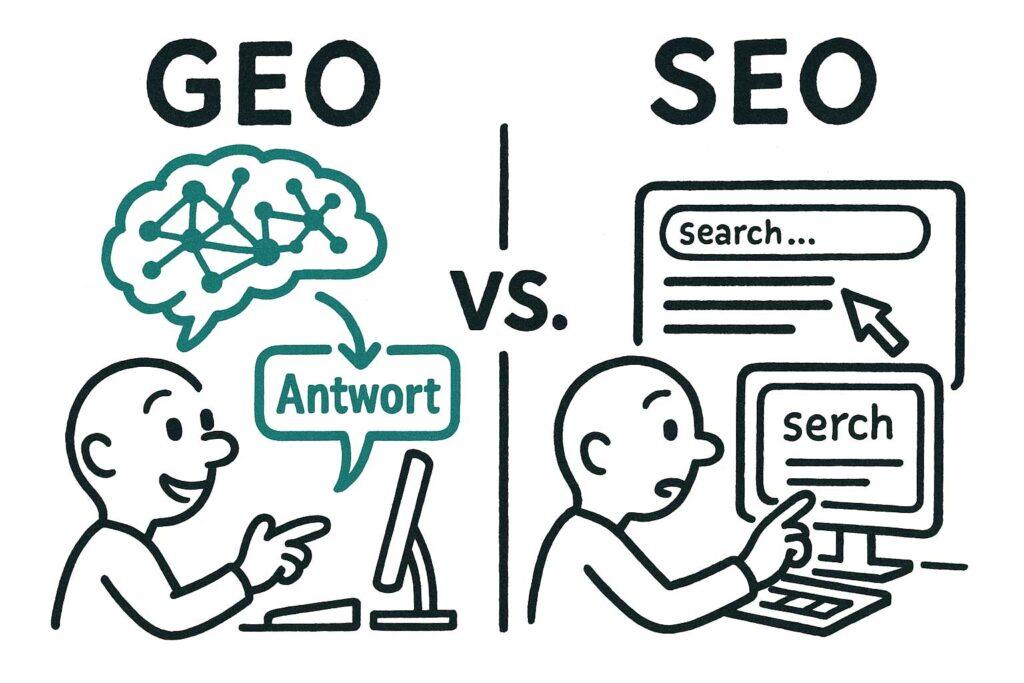
Search engines based on artificial intelligence are currently fundamentally changing how online content is found and evaluated. Systems such as ChatGPT, Perplexity, or the new Google AI search go far beyond traditional lists of results. They analyze content, connect it with their own knowledge, and deliver a direct, content-based answer. These search engine AI models show how strongly AI (artificial intelligence) is already shaping the digital flow of information.
For your website to remain visible in AI search optimization and in modern AI models, an adapted approach is required. On the one hand, content and technical structures should be designed so that they can be clearly understood by AI systems, for example in Google AI search or in ChatGPT. On the other hand, a clear positioning of your brand plays a crucial role, as it influences how your content is classified by intelligent AI models.
We support you in designing your website and content so that they are correctly interpreted in AI-powered search environments. With targeted AI SEO, optimization for AI, AI marketing, and modern approaches such as Generative Engine Optimization (GEO) and Large Language Model Optimization (LLMO), you secure visibility for your brand – both regionally and beyond – in a search landscape that is increasingly shaped by artificial intelligence.
Question: What is GEO/LLMO?
GEO stands for Generative Engine Optimization and LLMO stands for Large Language Model Optimization. Both terms refer to the optimization of content and structures for generative search engines. Traditional SEO mainly focused on rankings. Today, however, the goal is to be present in AI-generated answers. Content and page structures must be presented in a way that makes them semantically relevant. The aim is to be recognized, cited, and presented as an answer by AI systems. In this way, the target audience is reached not through rankings, but through clear, informative texts, statistics, evidence, and understandable explanations.

Why is optimization for AI important?
AI systems such as ChatGPT or Perplexity do not search the web the way Google used to. They use structured content, semantic connections, and contextual understanding – classic SEO alone is no longer sufficient.
- You are not mentioned by AI – even though you rank.
- Your content is not optimized for machine-generated answers.
- ChatGPT prefers to refer to your competitors.
Important AI tip for companies:
In the future, only those who structure their content so that AI systems can understand and classify it will remain visible.

How to be found in AI answers
In the past, people used search engines like Google to find information. They entered their questions, reviewed search results, clicked on various links, and compared content manually. The user therefore did most of the work themselves. Today, this process is automated. Users ask their questions directly to AI systems such as ChatGPT, Copilot, or Gemini. These tools combine their own knowledge with current web content and deliver clear, relevant answers immediately. For companies, this means: anyone who wants to remain visible in the future must design their brand, website, and content so that they are not only accessible and understandable for people, but also easy for AI systems to access, interpret, and trust. The central question is therefore no longer: How do we reach position 1 on Google?
But rather: How do we appear in AI-generated answers?
You are currently viewing a placeholder content from YouTube. To access the actual content, click the button below. Please note that doing so will share data with third-party providers.
More Information
Our services for your AI visibility
- Optimize content specifically for GPT, LLMs & AI systems
- Development of AI SEO strategies specifically for ChatGPT, Gemini & Co.
- Creation of AI-readable content with clear structure & semantics
- GEO-optimized topic planning and content structuring
- Monitoring and continuous adjustments based on AI response patterns
Frequently Asked Questions
For ChatGPT and other AI search engines, people no longer speak of traditional SEO, but of GEO (Generative Engine Optimization). It describes the optimization for generative AI models so that content becomes visible in their answers and is correctly recognized.
“AI” stands for Artificial Intelligence. It refers to technologies that learn from data, recognize patterns, and based on that make suggestions or decisions.
GEO stands for Generative Engine Optimization and includes strategies that prepare content in a way that allows generative AI models to reliably find, understand, and cite it.
Definitely! SEO is changing, but it is not disappearing. SEO remains a central building block of online visibility. It is not replaced by GEO, but rather significantly complemented and expanded in order to be present in generative AI answers.
AI is changing how search engines evaluate and deliver content. Content is no longer analyzed superficially, but interpreted semantically. Clarity, expertise, and context are now the main focus.
Yes, as long as GEO is understood as a professional complement to SEO. It is a legitimate concept based on verifiable methods. The key factors are transparency, verifiability, and semantics.
GEO ist für alle relevant, die auch in der Zukunft die digitale Sichtbarkeit behalten möchten.
No, ChatGPT or other generative search engines can make parts of the work more efficient. However, the strategic planning, prioritization, technical implementation, and continuous evaluation of SEO measures must still be reviewed by humans.

uvex safety
SEA / SEO

Franken Tourismus
SEA / Video Marketing

HABA
SEO / SEA / Social Media

PSD Bank
SEA / Social Media
Our services:
- Google Search
- Google Shopping
- Google Display
- Remarketing
- YouTube
- Bing Ads
- LinkedIn Ads
- Facebook Ads
- TikTok Ads