
AI in Online Marketing
Artificial intelligence is fundamentally transforming online marketing and driving a clear shift from intuition-based decisions toward data-driven strategies. Modern tools such as ChatGPT or Gemini, AI-supported analytics platforms, and intelligent agents help companies systematically analyze responses from artificial intelligence and better understand the search behavior of their target audiences. This enables them to make more informed marketing decisions and manage their campaigns more precisely. At the same time, it is becoming increasingly important to be visible within artificial intelligence systems at all. Search engines such as Google now display AI answers directly in the search results, and this is exactly where new opportunities arise to be present through search engine optimization.
Whether automatically generated texts, AI-generated images and videos, hyper-personalized customer processes, advertising where AI itself sets the appropriate price per click, or analyses for search engine optimization and sentiment insights: artificial intelligence makes marketing both faster and more creative. Companies can use AI to produce content more cost-effectively and better predict developments. Above all, however, it becomes possible to address customers much more precisely and appropriately – instead of relying on general mass advertising. This significantly improves the return on investment. One thing is clear: AI does not replace marketing professionals, it supports them. Expertise, strategic thinking, empathy, and creative ideas remain essential to truly unlock the potential of intelligent technologies.
Artificial intelligence is fundamentally transforming online marketing and driving a clear shift from intuition-based decisions toward data-driven strategies. Modern tools such as ChatGPT or Gemini, AI-supported analytics platforms, and intelligent agents help companies systematically analyze responses from artificial intelligence and better understand the search behavior of their target audiences. This enables them to make more informed marketing decisions and manage their campaigns more precisely. At the same time, it is becoming increasingly important to be visible within artificial intelligence systems at all. Search engines such as Google now display AI answers directly in the search results, and this is exactly where new opportunities arise to be present through search engine optimization.
Whether automatically generated texts, AI-generated images and videos, hyper-personalized customer processes, advertising where AI itself sets the appropriate price per click, or analyses for search engine optimization and sentiment insights: artificial intelligence makes marketing both faster and more creative.
Companies can use AI to produce content more cost-effectively and better predict developments. Above all, however, it becomes possible to address customers much more precisely and appropriately – instead of relying on general mass advertising. This significantly improves the return on investment.
One thing is clear: AI does not replace marketing professionals, it supports them. Expertise, strategic thinking, empathy, and creative ideas remain essential to truly unlock the potential of intelligent technologies.
Why is the visibility of your brand in AI search results so important?
Because your brand appears exactly where people search for solutions: in the answers of AI search systems. In this way, your content is selected more often, better understood, and can directly contribute to decisions. A focused, AI-supported further development of your website, content, and brand ensures that your offerings are clearly recognizable and classifiable for AI models – and therefore also more visible and relevant for your target audience.
- Customers search differently: Users today do not only ask Google, but also chatbots and new search engines such as ChatGPT, Perplexity, or other AI search systems. As a result, visibility and reach are changing. Companies must learn how to optimize their websites for AI so that AI models correctly understand content and present it as an answer.
- New search logic through AI: Modern, AI-supported search systems no longer analyze content only based on individual keywords. They recognize connections, meanings, and the intent behind a search. Classic SEO alone is no longer sufficient for this. AI SEO means building and structuring content in such a way that AI models understand it contextually, classify it correctly, and prioritize it in AI answers and new search interfaces.
- AI agents operate fully autonomously: They can take over research, analysis, content creation, optimization, and even parts of campaign management. These digital assistants run around the clock, automate recurring tasks, and make processes more efficient – while humans set goals, review results, and provide strategic direction.
- AI makes marketing more precise and intelligent: Artificial intelligence analyzes large amounts of data within seconds and identifies patterns that people can easily overlook. This makes it possible to address target groups more precisely, continuously improve campaigns, and allocate budgets more effectively – from Google Ads to CRM, with clearly measurable results.
- AI creates room for creativity and scaling While AI takes over routine tasks such as reporting, content creation, or testing, marketing teams can focus on strategy, idea development, and brand building. Generative AI makes it possible to produce texts, images, and videos for different target groups much faster. This results in more high-quality output in a shorter time – without sacrificing creativity.

Where can AI agents specifically make your work easier?
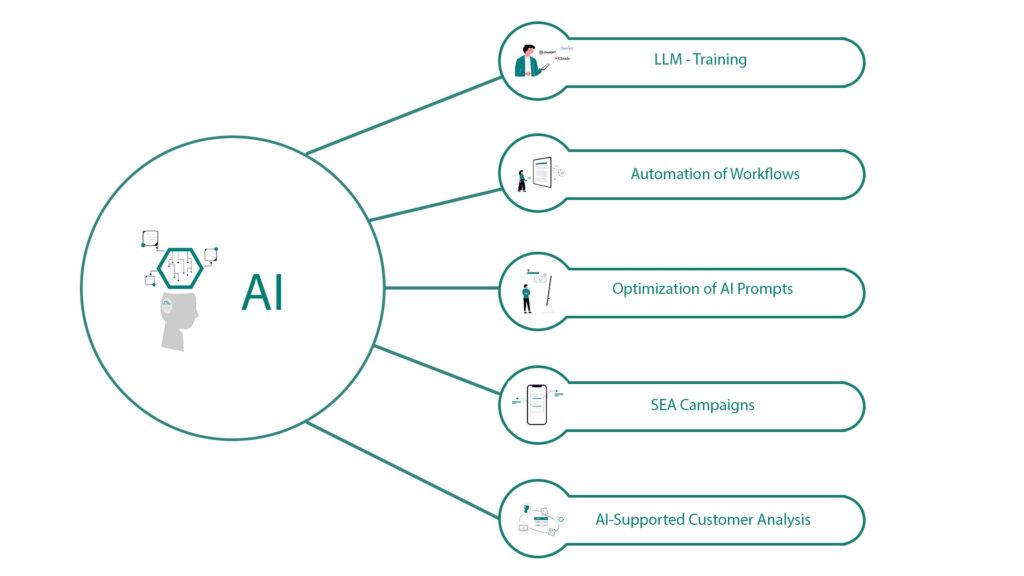
To turn good AI ideas into reliable results, a system is needed. The following graphic summarizes the most important building blocks: from LLM training to the automation of workflows and the optimization of AI prompts, all the way to SEA campaigns and AI-supported customer analysis. Together, they show how AI not only generates ideas but also supports entire workflows. LLM training ensures that models understand your content, technical language, and tone of voice. Automation transforms routine tasks into stable and reliable workflows with clear handovers. Prompt optimization ensures quality through defined goals, roles, and examples so that results are consistent and repeatable. In channel operations, AI supports SEA campaigns by consolidating search intentions, varying ad copy, prioritizing tests in a meaningful way, and turning results into concrete actions. The foundation for all of this is provided by AI-supported customer analysis, which consolidates signals, presents segments, and enables messages to be delivered effectively along the customer journey. Together, this creates a system that learns faster, produces more consistently, and delivers measurably better results.
In 5 steps to the AI level
Strategy, practice, and clear numbers – so that AI in marketing does not remain theory, but delivers results. In Leipzig and Nuremberg, we are personally at your side; remotely, we support you from anywhere. The result: less gut feeling, more impact.
- Step 1: Understand where you stand We analyze your company and show how well you are already prepared for AI – and where real potential lies.
- Step 2: Strategy instead of chance Together we develop a realistic plan for how AI can improve your visibility, reach, and customer retention.
- Step 3: Implementation with the right tools We select proven AI solutions that fit your business model and support you from the idea through to implementation.
- Step 4: Data that shows impact We help you structure your data so that AI can understand it, connect it, and use it profitably.
- Step 5: Make success visible With reports and clear metrics, we show how AI improves your performance – transparent, understandable, and sustainable.

Frequently Asked Questions
AI SEO refers to the use of artificial intelligence to specifically analyze and optimize content, keywords, and rankings. The goal is to better understand search engines and AI systems and make your brand visible where decisions are made.
AI visibility means that a company appears not only in traditional search engines but also in AI systems such as ChatGPT, Perplexity, or Copilot. It is about ensuring that AI models understand content, consider it trustworthy, and recommend or cite it in their answers.
AI has fundamentally changed search engine optimization. Algorithms today no longer recognize only keywords, but also understand topics, connections, and user intent. As a result, high-quality, relevant content has moved more strongly into focus than pure keyword optimization.
SEO for AI is usually referred to as AI SEO or KI SEO. The goal is to optimize content so that it is not only found in traditional search engines, but also correctly understood and recommended by AI systems such as ChatGPT, Perplexity, or Copilot. A newer term in this context is GEO (Generated Engine Optimization). GEO describes the targeted optimization of content for generative AI platforms so that your own content appears directly in AI-generated answers.
No, but it significantly changes them. Classic SEO principles such as technology, structure, and user experience remain important. AI expands these strategies through data-driven analyses, automated optimizations, and more precise content recommendations.
AI can assist with keyword analysis, topic discovery, text structure, and formulation. However, human editing remains essential for tone, authenticity, expertise, and strategic direction.
Google itself uses AI technologies such as RankBrain or Gemini to evaluate content more effectively. Those who provide clearly structured, relevant, and high-quality content will also be more visible in AI-supported rankings.
AI supports research, structure, and text suggestions. The greatest benefit arises when AI is used as a tool and humans provide the finishing touch with expertise, experience, and creativity.
Clear structures, semantically structured content, and clean technical implementation are crucial. AI systems understand relationships, so content must be logically structured, up to date, and thematically precise.
Absolutely. SEO is not a declining discipline; it is evolving. Those who invest today in high-quality content and AI-supported optimization will secure long-term visibility and trust even in an AI-dominated search landscape. Those who recognize early that SEO and GEO complement each other ideally will benefit the most in the future, because visibility no longer arises only in search results, but increasingly directly in AI-generated answers.
Traditional SEO is based on fixed rules, keywords, and backlinks. AI SEO uses machine learning to dynamically evaluate content and recognize patterns in user behavior, making optimization more precise and individualized.
AI can analyze data, optimize content, personalize campaigns, or automate customer service. This leads to more efficient processes, better decisions, and measurably higher reach. However, you should not copy everything, but instead let the results inspire you.
As a private individual, you can use AI in many different ways, whether for planning your next vacation, organizing everyday life, or helping with study notes and job applications.
It is difficult to say what AI will “never” be able to do. According to the current state of research, AI cannot develop subjective feelings, inner experiences, or its own consciousness. Responsibility, moral judgment, and legal liability also remain with humans. Whether this may change in the future cannot be answered at this time.